Electronics
Fault-finding and repair at board level. When the control board is obsolete, repair is often the fastest route back into operation.
What the work involves
Electronics work is often what rescues a delivery date. Equipment on board and in industrial plants has a long service life, while the electronics inside it goes obsolete long before the plant does.
Board-level fault-finding
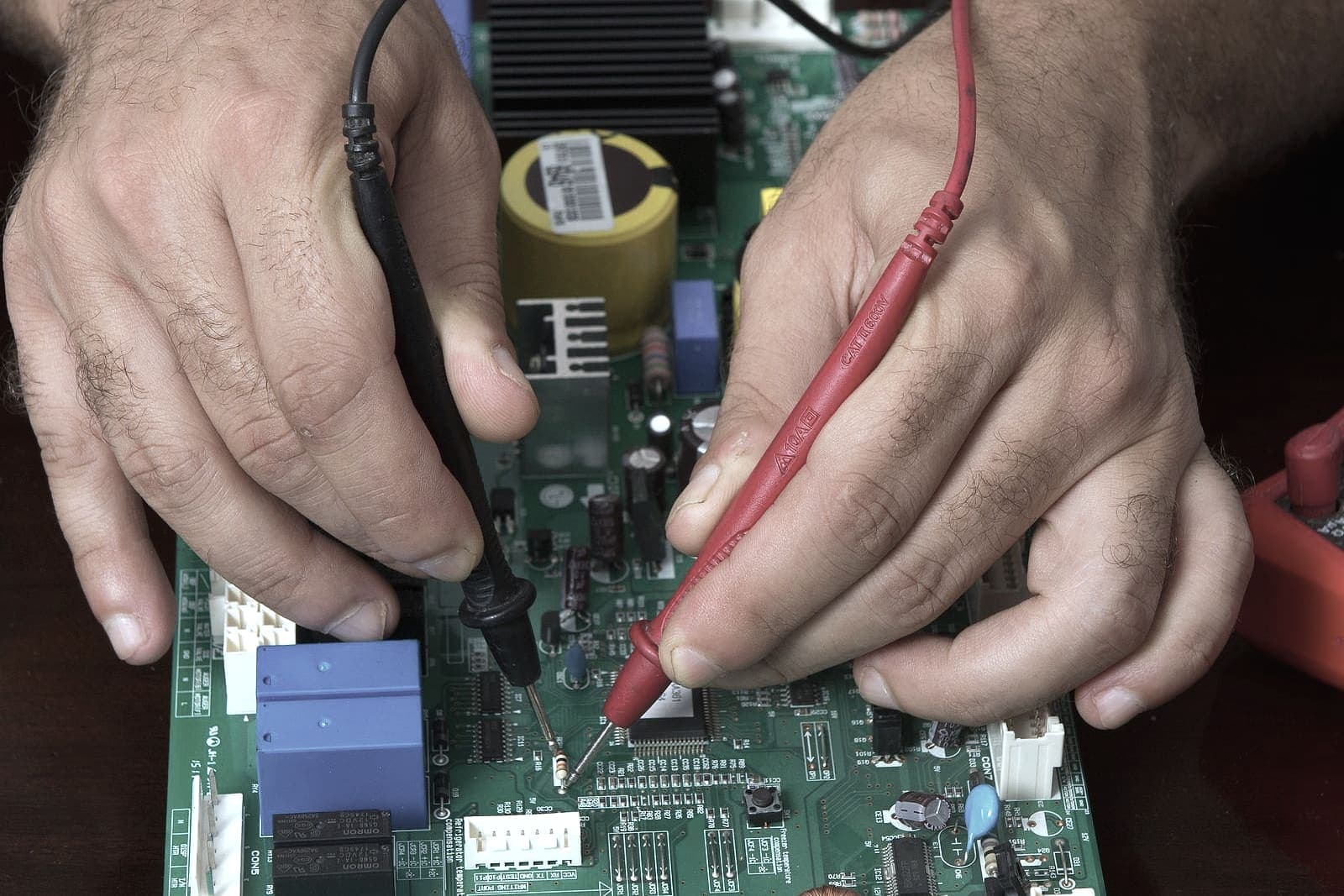
We locate the fault on the board, not just in the cabinet. Measurements, comparison against a working board where one exists, and a conclusion about what is actually defective, before anything is ordered. That is the difference between repairing and swapping parts until the fault disappears.
Repair and component replacement
Soldering, component replacement, repair of broken tracks, dry joints and contact faults. The board is function-tested on the bench before it goes back into the plant, so that the first start-up after the repair is not also the test.
Obsolete parts
When the manufacturer no longer supplies, the choice is usually between repair, an adapted replacement or rebuilding the control system. We set out what each of the three costs in time and money and let you make the decision, including when the conclusion is that the board is not worth saving.
Cables and adaptations
Manufacture of cables, adapters and interfaces, and small modifications that let new equipment fit into an older installation without everything around it having to be replaced at the same time.
Equipment we work with
Automatic voltage regulator from EMRI. Photo: EMRI.

What we do
- Fault-finding down to component level on control, power and signal boards.
- Repair: soldering, component replacement and repair of broken tracks and dry joints.
- Bench function testing before the board is refitted into the plant.
- Assessment of whether repair, replacement or a rebuild pays off, with figures for both.
- Manufacture of cables, adapters and interfaces.
- Modification of existing equipment where a new function has to go into an old installation.
- Sourcing and qualification of replacement components where the original is obsolete.
- Documentation of what was found, what was replaced and what was measured afterwards.

Questions we are often asked
Can you repair boards the manufacturer no longer supplies?
Often, yes. Obsolete boards are one of the most common reasons people get in touch. We examine the board, determine what is defective, and tell you whether it can be repaired. We also tell you whether the repair is sound enough to put back into service for good, or whether it mainly buys you time for a planned replacement. Either can be the right answer, but you should know which one you have been given.
What do you need from us to get started?
The board itself, and as much as you know about how the fault presents: what the plant was doing when it stopped working, whether the fault comes and goes, and whether anything was replaced beforehand. If you have wiring diagrams or a type designation, sending them along saves time. If the documentation is missing entirely, it usually works out anyway: that is the situation in most of the cases that reach us.
Does repair pay off compared with replacement?
It depends on what a replacement actually involves. If the board is part of a control system where everything else still works, repair is almost always faster and cheaper than replacing the whole system, particularly when lead times on new equipment are long. If it is the third board to fail in a short period, the answer is different, and we will say so.

Equipment out of service?
The emergency line is staffed around the clock, all year. Talk to us before you order new equipment: it may not be necessary.
+47 47 177 177- Switchboard
- +47 47 444 888
Weekdays 08-16